Improving the quality of final effluent discharge continues to be a priority for wastewater treatment upgrades in the UK. However, choosing the right system for each application is challenging, especially where there may be conflicting demands of investment commitments, space considerations and ongoing maintenance requirements.
Paul Barter, Principal Process Engineer for Hydro International, looks at the increasing pressures on treatment works for meeting wastewater discharge consents and reviews the types of tertiary polishing technology that can achieve the desired standards.
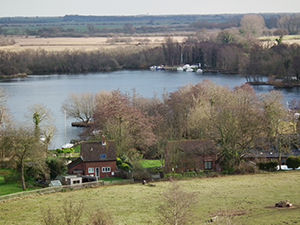
The choices made by water companies in operating tertiary treatment processes are critical for protecting sensitive river and coastal environments and keeping delicate ecosystems in balance. Just as importantly, wastewater treatment plant operators must consider the cost benefits of their investment not only in terms of initial capital outlay but also the ongoing costs of operation and energy consumption.
Municipal water companies are all too aware that the consequences of inadequate tertiary treatment processes can result in operators incurring punitive fines which are damaging both in terms of profitability and public reputation.
Key pollutants
The quality of final effluent discharge into the receiving waters is critical to the health of freshwater, river basin and coastal marine environments and regulated via the EU Water Framework Directive 2000 (WFD). The Environment Agency is responsible in England, Northern Ireland and Wales for ensuring discharge waters meet the river basin cleanliness targets imposed by the WFD.
As such, each plant is allocated discharge consent limits by the EA for designated critical pollutants, such as suspended particles, ammonia, nitrates, phosphates or metal ions (which are added in order to achieve the phosphate consent) and other specific pollutants.
Each of these pollutant limits is controlled by the tertiary treatment of water passing though treatment plant where this is in place to supplement the primary and secondary treatment phases.
Selecting the right tertiary technology
It is important that an expert assessment is made of any site before recommendations for the most appropriate technology can be made.
There are three basic options for tertiary treatment technology for final polishing:
- Conventional sand filter beds
- Continuous upflow sand filtration
- Mechanical disk or microscreen filtration
The most commonly used tertiary method is sand filtration including deep bed filtration, continuous upflow filtration, pressure sand filtration, or rapid gravity filtration. Sand filtration has been popular over several decades because the method is robust and able to cope with a variable loading of pollutants and flow conditions in treatment.
In all sand filtration methods, the sand particles have a very large surface area which captures suspended matter from the wastewater and traps it within the sand bed. The trapped material can be TSS, BOD, phosphate or even iron, thus removing it from the water.
Some systems enable upgrades of the standard filtration system to allow more intensive removal of pollutants such as ammonia or nitrates. This is achieved by encouraging biomass to grow on the media which utilise these components as part of their metabolism, thus removing them from the flow. Additions such as aeration or carbon sources may be required in order to achieve these goals.
Operational issues
Deep bed, rapid gravity and pressure sand filtration are effective, but sand particles can become clogged and clump up with deposited matter, so performance deteriorates with time. Effectiveness is regained by washing the particles forcefully with water and air. The resulting dirty washwater is recirculated through the treatment system to treat the waste removed from the sand; this means that plant may have to be taken out of the treatment cycle.
To accommodate the water volumes, gravity fed beds typically occupy a significant area of a treatment plant. With periodic maintenance needed, additional redundant beds are required as back-up to ensure continuity of treatment.
The less common pressure fed filter units used on low head sites are smaller, with a lower throughput, require significant energy, and also require additional units for maintenance back-up.
Further issues occur when higher plant throughput volumes and more rigorous and specific treatments are required than the filtration is designed for. Gravity beds are difficult to upgrade, expensive to build and occupy valuable land, while pressure filtration is expensive to install and run. This can put wastewater treatment works at risk of high penalties where discharge limits are exceeded.
Continuous upflow sand filtration
Proven for 30 years, continuous upflow sand filtration technology combines robust day-to-day operation with versatility to meet specific treatment requirements. Housed in vertical silo units, continuous upflow sand filtration technology minimises land use, while providing efficient and effective large volume/high load filtration for the footprint; typical flow volumes to be treated can be four or five times that of the same area occupied by a conventional filter bed.
Continuous upflow sand filtration technology also features a continuous back washing action, which greatly reduces the incidence of clogging and allows pollutants to be removed continuously. As a result, maintenance requirements for sustaining the performance are low. Thus, water purification and sand washing both take place continuously enabling the filter to remain in service without interruption.
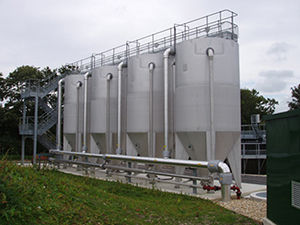
DynaSand® from Hydro International
Typical continuous upflow sand filtration technology is the DynaSand®, DynaSand® Oxy and DynaSand® Deni from Hydro International.
Pollutant treatment
Three types of pollution can be treated with essentially the same design equipment, phosphate removal, denitrification of nitrates and nitrites and ammonia. This is achieved by using specific flocculants (iron or aluminium salts for phosphates), or creating the appropriate conditions with bacterial cultures (nitrifying or denitrifying). Very low phosphate consents can be achieved with the DynaSand® down to 0.1 to 0.2 mg/l total P which will become more important in order to meet the consents of the future.
The compatibility of continuous upflow sand filtration with different upstream primary and secondary wastewater treatment processes, such as trickle and activated sludge treatment plant, ensures it is versatile enough to meet most requirements.
Additionally, there is no need to build in stand-by capacity, saving in capital expenditure.
Indeed, using continuous upflow sand filters enables installations to be expanded easily by adding additional units whilst the footprint remains small.
Mechanical disc filtration
Mechanical disc filter systems offer high efficiency microscreen filtration which can be precisely tailored to waste water composition, flow and discharge requirements.
A comparatively new process that originated in the paper industry, disc filter systems have been used for tertiary solids removal during the past ten years or so. Sites with higher flow rates and a low and predictable load of suspended matter are suitable. Typical of disc filter equipment is the DynaDisc® from Hydro International
As well as this type of equipment’s very compact footprint, it has low head requirements, so useful where space options on a site are constrained. The performance in suspended particle removal is high for excellent water quality where further treatments are not required. Maintenance and power requirements of well-designed units are generally moderate; the main maintenance action is regularly checking the cassettes, which takes minimal downtime.
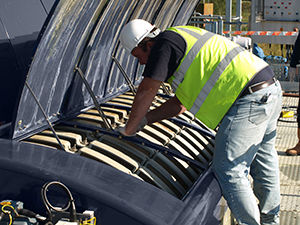
Maintaining DynaDisc®
Improving existing plant
As well as looking at the whole process of tertiary treatment, and the major methods which offer different choices, we should also consider treatment plant where final polishing is not performing to design standards. Overhauling existing plant to optimise its operating efficiency can reduce operating costs and extend plant life, avoiding the need for new capital expenditure.
Meeting the challenge
Matching the current and planned needs for high quality wastewater tertiary treatment is increasingly critical in a regulatory climate which is moving to ever more rigorous standards. Wastewater treatment plant operators must consider the cost benefits of their investment, not only in terms of initial capital outlay but also the ongoing costs of operation and energy consumption, and the punitive fines and loss of reputation from adverse publicity if pollution affects the environment. Choices between upgrading existing plant, adding or refining treatment processes, and installing new plant and processes must be carefully weighed up.
In conclusion, while the focus on final standards and tertiary treatment is becoming more intense, we do have established tools and techniques to address the situation. Before significant improvements or extensions are made to existing facilities, or new ones are built, careful planning should be undertaken of every stage.
Contact Hydro International for more information on wastewater treatment solutions.