The assault on water quality in our streams, rivers and coastal marine can seem endless. On the one hand we have a looming primary target date, set for 2015 by the Water Framework Directive. By this time, all the myriad fixes we are applying to our creaking water supply and treatment infrastructure are supposed to have achieved their transformations.
On the other hand, we are beset by energy and economic crises, which affect treatment plant operation, dwindling ground water supplies, increasing population with changes in food supply and agricultural practices. Climate uncertainty is another factor which casts its own shadow.
Final quality and pollution sources
Of course 2015 – important as it is - is still just a milestone on the ultimate road to quality water; new objectives will be set for 2030 and beyond, while the problem issues will not magically disappear.
However, the general feeling is that our own hydrosphere, i.e. source to coastal marine, is mainly failing on two aspects from meeting WFD objectives. These aspects are the ammonia / nitrate and phosphate levels; a major source of these has been agriculture.

Diffuse problems
Point source ammonia pollution in agriculture usually results from accidental spills. With diffuse source pollution, where surface water run off can create problems up and down a water course, it is more difficult to isolate the origin; ammonia is still a major component, although nitrate and phosphates from fertilisers are becoming less important.
Additionally, polluted first flush run off after drought can deliver a concentration which encourages aquatic plant growth, raises the Biological Oxygen Demand (BOD) and create fauna kill conditions; where the normal diffuse levels are non-toxic.
It must be acknowledged that the agricultural industry is improving its pollution profile across the UK, but it will take many years to achieve a major improvement.
Finding short term wins
So while gradual improvement is under way, can we look for short term reduction in other sources of ammonia pollution to help overall water quality? The answer is that accelerating ammonia conversion in the local sewage and waste water treatment works could help achieve fairly rapid benefits.
This creates a possible conflict. Ammonia production is a part of the sludge treatment process; however, today’s energy and cost pressures on the engineers at the treatment works have been changing the treatment approach.
Energy generation dilemma
Carbon footprint reduction through exploitation of the major source of ‘free’ energy is being widely developed at many treatment works. Biogas derived from anaerobic digestion is largely methane which is burnt in combined heat and power plants. Other processes under investigation include co-digestion with food waste and incineration of dewatered sludge to produce heat.
Anaerobic digestion produces waste liquors with relatively high ammonia content. The engineer’s dilemma therefore, is to try and meet the energy targets without missing the pollution targets.
As a result, the works should be geared for an extra ammonia problem, and provision must be made for treatment as the existing facilities may have insufficient capacity.
Ammonia treatment choices
Providing ammonia removal at secondary or tertiary treatment stages normally requires either a percolating filter bed, which can occupy a significant area. Alternatively, storage of activated sludge in tanks has a sludge age of 15 days and needs significant storage volume.
Both of these can be difficult to accommodate if increased treatment capacity is required. Both of these require energy in the form of mechanical spraying, agitation and aeration. After completion, settlement of solids from both processes is carried out as a tertiary or final polishing treatment.
Added tertiary treatment
What if a treatment works cannot increase its secondary treatment processes? The solution lies in a bolt-on tertiary treatment. One is the use of biological aerated filtration (BAF) processes. The energy consumption of the process is significant, and the liquor still generates solids in suspension, which must be removed before final discharge, so requires polishing.
Another tertiary treatment which has shown a significant degree of success is the use of vertical sand filters contained in silo shaped vessels up to 10 metres in height and three metres in diameter. This versatile treatment can be used for removal of suspended solids for final polishing of suspended matter prior to discharge. Additionally it may be employed in converting ammonia to nitrate or nitrate to gaseous nitrogen by creating the appropriate aerobic or anaerobic internal regime and introducing the required oxygen or organic carbon source.
Small footprint, large equivalent
Major benefits include the small footprint, which is equivalent to up to 17,000 sq.m. of conventional percolating filter bed per vertical vessel. The vessels can be grouped to provide flexible capacity or as consecutive treatments from ammonia removal to polished water discharge; eight or ten are frequently installed together in a very efficient use of space.
The unit operates by water for treatment piped into the lower levels of a sand bed. The liquid is allowed to flow upwards through the sand bed until the treated water is discharged at a high level near the top of the filter. The contaminated sand is drawn to the bottom where it is lifted by air pump and cleaned in the sand washer at the top of the vessel.
The contaminated solids are drawn off on a separate water flow and returned to the treatment works. The cleaned sand is returned to the sand bed where it gravitates to the bottom of the silo, becoming more contaminated again as the introduced water trickles up through it.
Ammonia and nitrate conversion
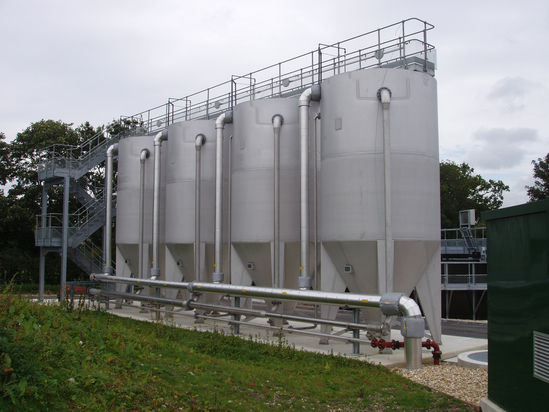
In the ammonia process, seeding of the sand bed with nitrosamonas, nitrobacter and a continuous controlled dosage of oxygen ensure the correct aerobic conditions to transform the ammonia to nitrate. In fact, a standard suspended solids treatment process such as DynaSand®, can be adapted to add a degree of ammonia conversion (DynaSand® Oxy) by including an oxygen source and adding the bacteria.
In a denitrifying process such as DynaSand® Deni, the anaerobic regime is maintained using a film of different bacteria with controlled dosage of methanol as an organic carbon source.
As both these processes are tuned to the pollutant content of the incoming liquors, they can be better and more precisely controlled and more cost effective than if conversion occurs during secondary treatment in the works.
Low whole life costs
Vertical filter bed systems are able to operate for a long time with minimal maintenance and low energy requirements, as mechanical components are very few. To maintain high effectiveness, only periodic inspection is recommended to ensure optimal internal conditions.
Making the right choices
Ammonia reduction in the water environment, and associated nitrate removal, is essential to reaching our WFD targets in the immediate future and maintaining our hydrosphere quality in the decades to come.
While we continually strive to reduce agricultural pollution in the long term, we should not forget that quick gains can be made through upgrading our existing sewage treatment, despite the needs for improved energy generation processes.
With appropriate equipment selection, we can all achieve optimum quality and efficient operation, as well as the flexibility to cope with the demands of increasing population pressures.