

- Project type
- New build
- Products used
- GEMÜ 554 globe valves and 490 butterfly valves
Context
The sterilisation of liquids plays a large role in pharmaceutical and biotechnological production. This is just as important in research and development and in the production of sterile goods as it is in handling parenteral solutions in hospital pharmacies.
The hot water cascade system developed by MMM Münchener Medizin Mechanik GmbH enables liquids in closed receptacles made of glass or other temperature-resistant materials (such as ampoules) to be sterilised quickly, reliably and gently.
The advantage of the hot water cascade system lies in its very short cycle times, which are achieved through a high circulation rate and cascade density in combination with short heating up and cooling down times.
Process
The chamber containing the item to be sterilised is filled to a pre-defined level (below the item being with deionised sterilisation water). This water then circulates through a steam-heated heat exchanger and cascades over the item being sterilised at a continuously rising temperature. This enables the item to be heated up in a quick and gentle way. In the subsequent cooling phase, the sterilisation water flows through the now water-cooled heat exchanger and cools the item being sterilised down to a specific temperature.
Application of GEMÜ valves
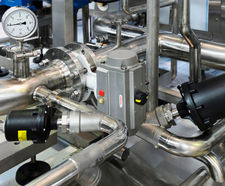
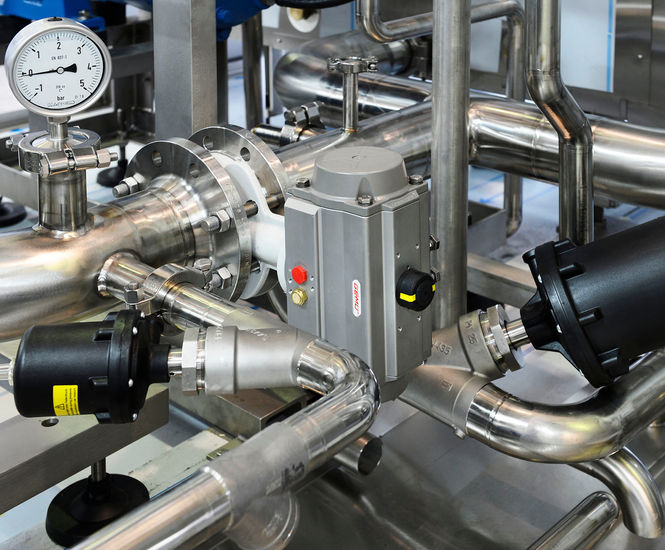
Pneumatically-actuated GEMÜ 554 globe valves control the filling of the sterilisation chamber with water and the way in which the heat exchanger is heated by steam and cooled using water.
By contrast, GEMÜ 490 butterfly valves are used in the circulation line, as these have significantly more compact installation dimensions yet very high flow rates in comparison with pneumatically-operated angle seat globe valves of the same nominal diameter.
Furthermore, to meet these stringent requirements, they are fitted with highly resistant TFM plastics TM and FDA-approved silicone as a sealing material.