

- Sector
- Utilities
- Project type
- Refurbishment
- Year completed
- 2022
- Project location
- Scotland
- Client
- Scottish Water
- Consultant
- Ross-Shire Engineering (RSE)
- Products used
- TUBEdek installation and new lamella media installed
In 2002, Scottish Water opened a new wastewater treatment works in Kirkcaldy, a town on the north shore of the Firth of Forth coast in central Scotland. The Kirkcaldy works was designed to service a combined residential and industrial population of approximately 61,000.
A relationship that started over two decades ago
Two years before the plant went into operation, in 2000, the main contractor, Kavaerna, commissioned 2H Water Technologies to manufacture and install media for use in the plant’s lamella separation tanks.
Lamella separation takes place during the pre or primary treatment stage prior to use of secondary wastewater treatment, such as Trickling Filters or Activated Sludge (ASP).
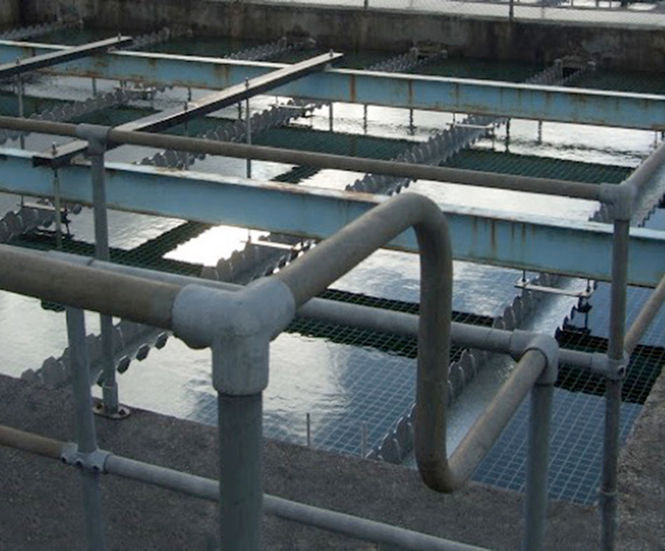
2H responded by manufacturing and installing 352m3 TUBEdek FS41.80 PVC lamella media in four tanks, each of which measured 8m x 8m wide.
Two decades later
Nearly two decades later, in 2018, when Scottish Water asked long-term framework partner, Ross-Shire Engineering (RSE), to drive an assessment and general upgrade initiative at the Kirkcaldy WWT plant. The TUBEdek installation was still providing an effective and reliable service.
As part of the initial assessment, RSE asked 2H to inspect and evaluate the condition of the TUBEdek installation at the Kirkcaldy WWT.
During the period it has been in operation, the Kirkcaldy plant has dealt with the changing wastewater treatment needs of an area.
Increased demand for wastewater treatment in Kirkcaldy
However, in recent years, the Kirkcaldy area has started to see significant revitalisation and regeneration, particularly around the town centre and along its waterfront, which will further increase the demand for wastewater treatment. In addition to the challenge posed by increased demand the Kirkcaldy plant, in common with WWT treatment facilities across the UK, can also expect to face increasingly tough environmental regulations.
After carrying out an on-site assessment, 2H supplied a detailed report which provided an analysis of the condition of the original TUBEdek media and support. The report recommended upgrading to a new TUBEDek media product – FS41.84 – which would provide a further 20 years of continuous, efficient operation.
2H also included detailed guidelines on replacing, and improving, the support system in the lamella separation tanks with specially formed GRP beams. Armed with 2H’s advice, RSE could carry out the work needed to upgrade the support system and therefore reduce the overall cost to Scottish Water.
RSE took 2H’s advice and, in 2019, placed an order for the updated version of TUBEdek (FS41.84) which, because it is manufactured in PP (polypropylene), is both more durable and more environmentally friendly than PVC.
TUBEdek offers more effective treatment
Unlike conventional clarification systems, TUBEdek tubular lamella settlers use a series of inclined plates which provide a larger, more effective settling area on a smaller footprint. The profiles have a unique chevron shape designed to facilitate counter current flow through the tubes. As a result, TUBEdek offers more effective treatment than easily blocked horizontal settlers and more expensive plate settlers.
RSE was also convinced by 2H’s recommendations for improving the support system. As part of the order, 2H was asked to manufacture a TUBEdek solution complete with 316 stainless steel walkway and hold down grids plus GRP support beams for installation in one of the plant’s existing tanks.
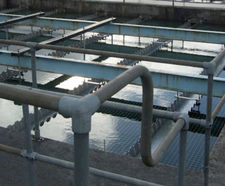
Adding a walkway/hold down grid on top of the media provides operators with safe access to the tanks and protection for the TUBEdek media during the cleaning operation.
A year after the walkway and support system was installed in the first tank, RSE placed another order with 2H for a set of TUBEdek complete with 316 stainless steel walkway/hold down grids and GRP support beams for a second lamella settlement tank.
Highlights of the project
New lamella media installed
Updated TUBEdek media
To meet increased demand
TUBEdek more effective