

- Sector
- Utilities
- Services provided
- Product manufacture
- Product supply
- Installation
- Project location
- London
- Client
- Kantor Energy Ltd
- Products used
- HB40R lamella settlement tank
Context
Kantor Energy is an energy-from-waste incineration facility whose operations involve the thermal treatment of household waste, which is combusted at high temperatures to produce energy.
The heat generated from the incineration process is used to boil water, creating high-pressure steam that drives a turbine connected to a generator. This enables the efficient conversion of municipal waste into electricity, providing a sustainable alternative to landfill disposal.
By recovering energy from residual waste, Kantor Energy contributes to reducing greenhouse gas emissions and supports the circular economy through responsible waste management and low-carbon energy production.
Challenge
Kantor Energy approached Siltbuster’s specialists for support with repeated blockages that were leading to operational challenges, downtime and a risk to compliance.
The cause was the presence of excessive solids in the runoff water from the ash storage area, which were collecting in the effluent treatment system. To ensure the system could operate effectively and without interruption, and to keep the site in compliance with its discharge limits, it was necessary to pre-treat the runoff to remove suspended solids before discharge into the foul sewer.
Solution
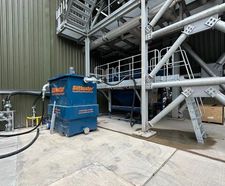
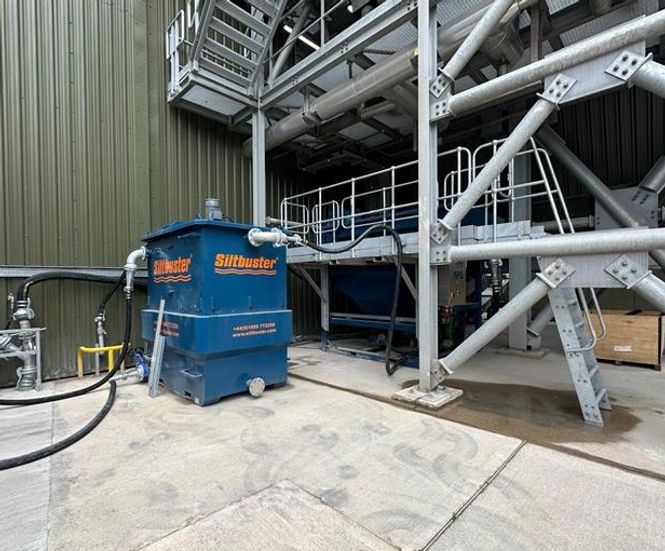
To address the solids loading issue, Siltbuster’s specialists supplied an HB40R lamella settlement tank designed to efficiently remove the majority of settleable solids from the runoff. The tank includes a series of angled metal plates which provide a large surface area, encouraging particles to settle to the bottom of the tank, from where the resulting sludge can be safely removed.
This was supported by an optional upstream polymer flocculation block, which enhances particle aggregation and improves settlement performance when required. A sludge holding tank was provided to receive the settled sludge from the base of the lamella hopper.
From there, the sludge is transferred to a filter press (supplied by a third party) for dewatering and final solids handling. The flow rate during day-to-day operation is quite low, but the unit was sized to accommodate higher flow rates when the plant shuts down and has a full clean carried out.
Result
The system successfully delivered significantly cleaner water for discharge to the foul sewer. By effectively reducing the solids load, the risk of pipe blockages was eliminated, resulting in smoother, more reliable operation of the effluent system.
This not only minimised maintenance interventions and associated downtime but also reduced the financial burden of trade effluent charges, as the improved water quality lowered the cost of discharge. Overall, the solution provided both operational and economic benefits to the client.