

- Sector
- Manufacturing
- Services provided
- Design
- Project management
- Construction
- Product manufacture
- Product supply
- Installation
- Year completed
- 2025
- Project location
- Wales
- Client
- Hafd Quarry
- Consultant
- Natural Resources Wales
- Products used
- MT30 mix tank
- HB50 lamella clarifiers
Context
Hafd Quarry in Monmouthshire, Wales, is a vital resource for a leading construction materials and building products business.
Materials sourced from the quarry are used in their operations to supply asphalt to projects of all sizes in the region – for example, ranging from major upgrades to the A465 to the filling of potholes.
During periods of heavy rain, water with high total suspended solids loading is generated from the quarrying activities. The company called upon Siltbuster’s specialists after a revision to the Environmental Permit for the site, issued by Natural Resources Wales (NRW), changed the consent conditions for discharged wastewater.
NRW reduced the storm flow levels on the site making it difficult for the client to operate at the quarry during the wetter months of the year.
Siltbuster’s experts were tasked with finding a water treatment solution that would allow year-round operations to continue at the quarry, while protecting the local environment and keeping the client in consent.
Challenge
Siltbuster’s preferred solution in most applications is to allow solids to either sink or float naturally, allowing them to be removed from the wastewater and leaving treated, clear water that can be safely discharged.
However, where high levels of suspended solids are present, as they were at the quarry, chemicals may be required to aid the natural processes.
NRW was initially reluctant to allow the use of chemicals on site. Following analysis of site samples at Siltbuster’s laboratories, the team held meetings with NRW representatives to answer questions and relieve concerns. These meetings included information about the stringent control measures used by Siltbuster to manage risk when using chemicals.
An additional challenge to overcome was the lack of attenuation on the site. This meant that Siltbuster had to provide a system that could cope with peak runoff rates as opposed to using an attenuation pond for balancing.
Solution
The Siltbuster laboratory completed an analysis of the expected influent water and specified the best chemical additives for settlement. From here, a system capable of handling 150-200m2 of wastewater per hour was proposed to the client. This was installed in early February 2025.
The system worked in several stages to remove contaminants and leave treated water that could be discharged safely.
First, wastewater was pumped from the small on-site lagoon into a dosing container utilising a high flow submersible pump supplied by Selwood, the UK-wide pumping solutions specialist and a sister company of Siltbuster in the Workdry International Group. At this stage, the flow was measured and the required chemical dose automatically determined in accordance to the flow rate entering the treatment system.
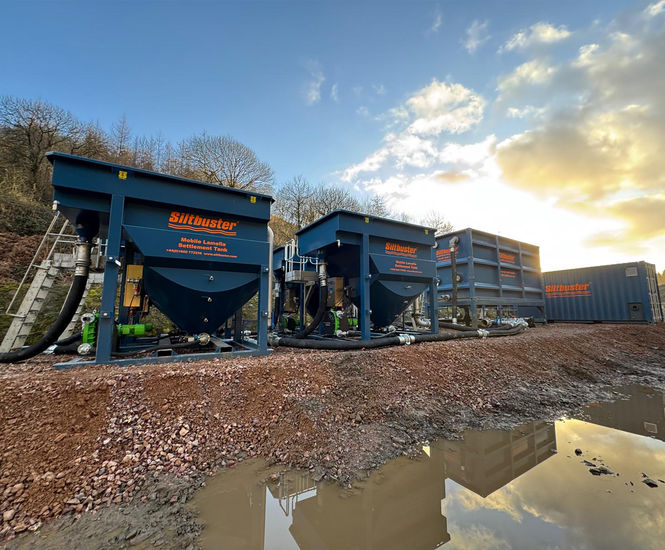
The liquid was then transferred to a Siltbuster MT30 mix tank where coagulants and flocculants are added. These help combine small particles, creating larger clumps that settle naturally.
The treated wastewater was then sent into four Siltbuster HB50 lamella clarifiers. These are settlement tanks, fitted with a series of angled lamella plates, providing an increased surface area to encourage the settlement of the sediment. The contaminants were collected in hoppers fitted with an automatic de-sludging system, reducing the time required by human operators to manually remove waste.
The contaminants, once separated from water, could be removed from the site, while the treated water could be discharged within the consent.
Result
Siltbuster’s approach reassured Natural Resources Wales about the use of chemical dosing and enabled the quarry to reopen for production.
Following the installation, works could also be carried out to allow additional attenuation to be installed, providing the conditions for a smaller and lower cost installation to be used at a later date.
Testimonial
Siltbuster’s approach, led by Technical Sales Engineer Harry Medlicott, was praised by the client who said: “Excellent support and collaboration with Harry. From my perspective, the preparation and support Harry gave during an onsite visit with the regulator (NRW) was second to none.”