



- Sector
- Manufacturing
- Project type
- Refurbishment
- Services provided
- Design
- Product manufacture
- Product supply
- Year completed
- 2025
- Project location
- Outside the UK
- Client
- Staunton Foods
- Consultant
- Montgomery EHS
- Products used
- Bioscrubber
Context
Staunton Foods is nestled in the picturesque village of Timoleague in rural West Cork, and has supplied quality pork and bacon products for over 70 years to both domestic and export markets. When odour issues arose, Montgomery EHS was consulted.
Solution
Identification of odour emission points
After reviewing volumes and concentrations of emissions from all identified points, odour samples were taken to determine the odour mass emissions.
An odour model was produced showing the odour impact around the site at residential and commercial receptors.
The data showed the odour reduction required to meet the regulatory ambient odour level and regulatory limits for receptors, currently 3 or 1 Odour Units (OUE/Nm³).
New odour control design
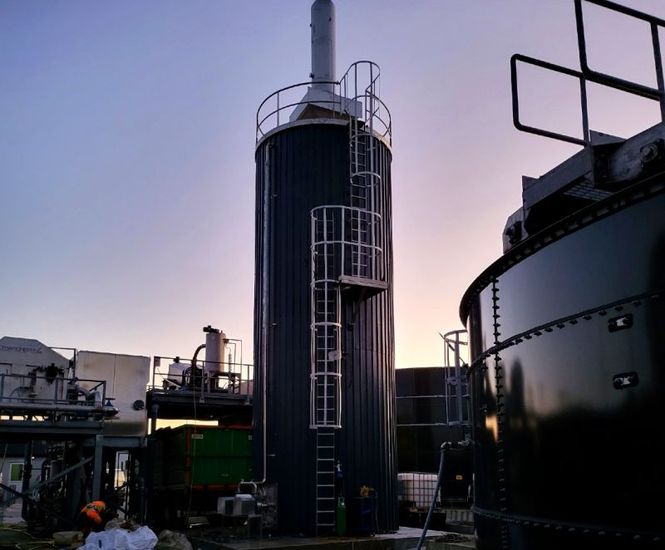
The preferred option was a bioscrubber in which the odour sources from the wastewater treatment plant are ducted to a fan which blows the potentially odorous air into the bottom of a 4.2 m diameter tower.
Water is continuously circulated from the bottom of the tower to spray distributors at the top which give even distribution of the liquid over the packing. The pH is automatically controlled between 8.5 and 9.5.
Bacteria in the circulating water biologically remove the odour producing contaminants.
The bioscrubber process:
Uses no hazardous chemicals
Has low maintenance
Has low operating costs
Control system
The control system allows continuous monitoring of pH, level, and flow.
Montgomery EHS remotely monitored the plant every day and visited the site weekly.
In the two years that the system has been operating, the hydrogen sulphide removal has been consistently greater than 95%.
Recycled plastic media used by the bioscrubber
The bioscrubber used 7m depth of Bioball filter media.
Bioball is manufactured in the UK by Warden Biomedia.
It is made from recycled polypropylene and provides a surface area of 220 m²/m³ which allows good contact between the liquid and gas.
The open structure, with a high voidage of 92%, means a low pressure drop on the gas side, minimising blower power and therefore energy consumption, helping the bioscrubber to run efficiently.
Read the full case study here: https://lnkd.in/e8AaQt3f