


- Sector
- Utilities
- Services provided
- Design
- Construction
- Client
- Stoddard County
- Consultant
- Environmental Dynamics International
- Contractor
- William A. Green & Associates, Baldwin, MO
Challenge
Stoddard County’s sewer district required a new wastewater treatment facility to service residential growth in the community. The criteria for the plant were not unusual for a small rural community; simple and easy to operate, a low operating cost, the ability to handle variable flows, and to provide the capacity to service a significant increase in population.
The projected effluent standards for the facility required ammonia removal which is typically not achievable with standard aerated lagoon technologies, which are often used in rural facilities.
To design a new treatment plant, the county’s sewer district contracted with William A. Green & Associates located in Baldwin, MO.
Solution
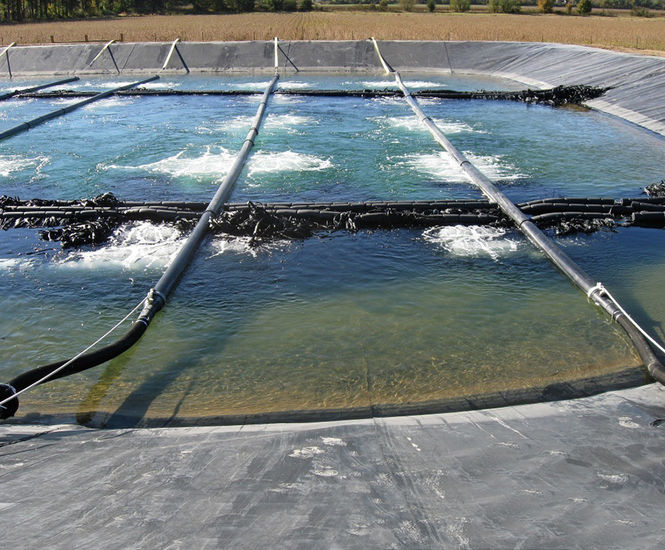
Responding to the wastewater treatment plant upgrade needs, Environmental Dynamics Inc. (EDI) proposed the ATLAS DBBR system. ATLAS DBBR is a lagoon-based extended aeration system that treats the raw wastewater using an intermittent intermediate flow. The design allows for continuous inflow of wastewater, sequenced aeration /mixing phase, followed by a settling phase, and finally the treated water is decanted and discharged to the downstream treatment ponds.
Equipment required for the ATLAS DBBR process included EDI’s floating lateral aeration system with FlexAir fine bubble diffuser assemblies, BioCurtain flow diffusion baffle, decant pipes with electric actuated valves, system control panel and rotary positive displacement blowers.
Outcome
The effluent quality provided by the DBBR process meets the requirement for year-round ammonia reduction. “EDI’s hybrid extended aeration process was designed with a varying water level to increase the capacity of the plant as the service population expands”, Patrick Ely, EDI Sales Manager, said. “The plant is uniquely suited to operate efficiently at both current loads and future load condition while keeping the operating efficiency at a maximum level.”