We have been helping designers and specifiers find the best solutions for their projects since 1988. ENVIROPRO is an ESI.info brand.
Activated coal-based carbon for treatment applications
Activated carbon is a crude form of graphite. It has a random imperfect structure that is highly porous over a broad range of pore sizes. It can have a surface of greater than 1000m2/g, meaning that 3g of activated carbon can have the surface area of a football field. This allows it to adsorb a wide range of compounds. Activated carbon has the
Activated carbon is a crude form of graphite. It has a random imperfect structure that is highly porous over a broad range of pore sizes.
It can have a surface of greater than 1000m2/g, meaning that 3g of activated carbon can have the surface area of a football field. This allows it to adsorb a wide range of compounds.
Activated carbon has the strongest physical adsorption forces or the highest volume of adsorbing porosity.
There are three main forms of activated carbon:
Granular activated carbon (GAC) comprises irregular-shaped particles with sizes ranging from 0.2 to 5mm. It is used in both liquid and gas phase applications.
Powder activated carbon (PAC) comprises pulverised carbon particles in sizes predominantly less than 0.18mm. It is used in liquid phase applications and for flue gas treatment.
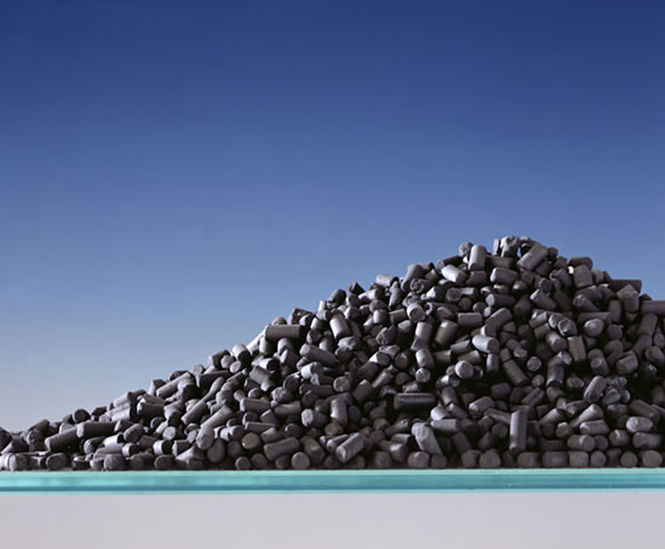
Extruded activated carbon comprises extruded and cylindrical shaped particles with diameters from 0.8 to 5mm. It is ideal for gas phase applications due to its low pressure drop, high mechanical strength and low dust content.
Activated carbon can be provided in special forms, including cloths and fibres, as well as briquettes in a variety of shapes and sizes. Coloured activated carbon is also available.