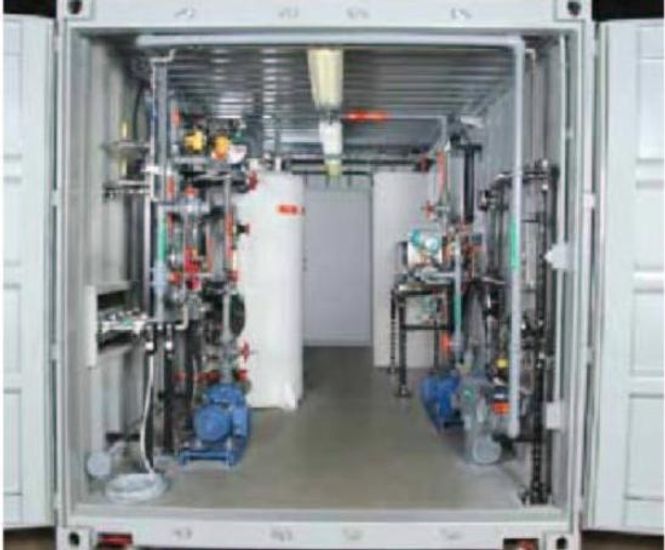


The SeaCURE™ ballast water management system uses a combination of physical separation and a propriatary, on-demand treatment with biocides that are produced insitu from seawater without the addition of chemicals. It is designed to offer complete compliance with the IMO Convention D-2 regulations for ballast water management.
The SeaCURE™ system treats ballast water only on intake, allowing the system to be sized for ballast water flows (e.g. one pump) while discharge can be coompleted with higher flow rages (several pumps). This makes it especially suitable for containers and bulk carrier ships that use one pump on intake and two pumps on discharge.
The system is based on three pillars, filtration, electrochlorination and demand-regulated control logic.
The major function of the filter is to remove of break up larger organisms using a 40micron weave wire screen, and to provide reliable, non-stop operation at high sediment loads at the same time as minimising backwash flow. The patent-pending biofouling control provided to the filter assures its reliable function and minimises maintenance requirements.
The electrochlorination module is used to produce a biocide, sodium hypochlorite (NaOCl), from seawater. It is then injected into the filtered ballast water to eliminate AIS. Sodium hypochlorite, a chlorine compound, has been used to prevent marine growth in seawater piping and heat transfer systems on land-based, offshore and shipboard installations for many years. By producing sodium hypochlorite electrolytically on demand insitu using a concentric tube electrode (CTE), the SeaCURE™ system is more efficient than standard hypochlorination processes.
The proprietary control logic of the SeaCURE™ system monitors the appropriate hypochlorite dose level necessary to provide the required efficacy, while avoiding any detrimental effects on the ship, its crew or the environment. Biocide dosing levels depend on the ballast water conditions.