Steam sterilisers in pharmaceutical applications are used to deactivate or remove unwanted micro organisms from soilds using a combined effect of steam and pressure.
Advantages of steam sterilisation:
- Effective cleaning
- No toxicity
- No environmental impact
- No toxic residues on the sterilised product
- Favourable cost-benefit ratio
Process
Chamber sterilisation is typically a four step process:
1. Loading
2. Venting/evacuation
3. Sterilisation
4. Post-processing and drying of the sterilised product
1. Loading the sterilisation chamber
The material must first be thoroughly cleaned to reduce bacterial exposure to a minimum even before sterilisation. It must also be pressure and heat resistant.
Safe, reproducible steam sterilisation which can be validated is only possible if there is free access to all external and internal surfaces of the product for the steam. This involves opening containers or lab equipment and dismantling complicated instruments. Furthermore, the material may not be packed in the baskets too tightly.
2. Venting/evacuation of the chamber
The sterilisation chamber must be completely vented before the actual sterilisation process takes place. Effective steam sterilisation can only be ensured if the steam has fully displaced the air in the chamber. There are several ways to achieve this which must be coordinated with the type of material to be sterilised.
When sterilising solids, fractionated pre-vacuum is a tried and tested method and is predominately used in modern sterilisers. In this process, air is vacuumed out of the chamber using a vacuum pump and replaced with steam. This process is repeated several times. Finally, steam is added until the required operating pressure is reached.
3. Sterilisation
If the saturated steam condenses on the sterilised material, thereby emitting energy, the protein in the cell is destroyed. It is essential that this heat is damp. While it is possible to sterilise with dry heat, it requires a considerably higher temperatures and longer exposure times.
4. Drying
Heating is started after the chamber has been evacuated. Normally, sterilisation is carried out at 121 °C for 20 minutes or at 134 °C for 5 minutes. Once this process is completed, the steam is vacuumed off and the chamber is evacuated to 120 mbar in order to dry the product.
Depending on the product, drying is carried out with a drying vacuum or air pulsation. Hot air drying is only required in rare cases. Any existing condensate evaporates due to the vacuum and is discharged via the vacuum lead and the GEMÜ 550 angle seat globe valves. Pulsated drying, during which the air is fed into the system in phases, has proven itself to be a tried and tested method. Before discharging, the chamber is cooled and pressurised with cooling water.
Types of steam
- Saturated steam (also known as pressurised steam): pure steam from boiling water
- Unsaturated steam: arises when there is insufficient water, i.e. the saturated steam does not fill the total space.
- Hot steam (also known as overheated steam): arises when saturated steam continues to be heated without water.
- Wet steam: arises when saturated steam cools down, e.g. during a pressure reduction, and contains water particles.
- Steam-air mixture: arises when steams flows into an air-filled space and has a lower temperature with consistent pressure.
Gemü valves for steam cleaning
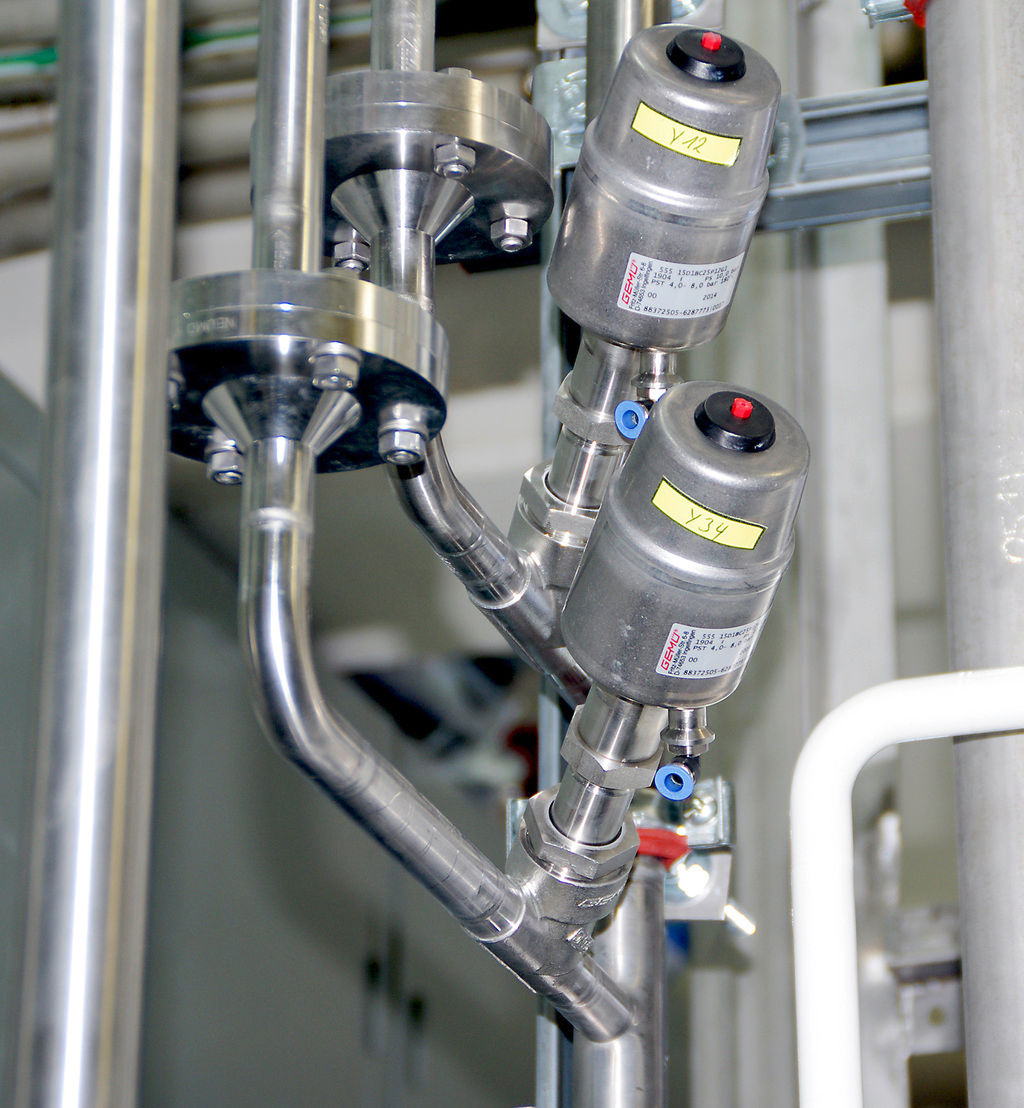
Gemü 550 all stainless steel globe valve is ideally suited to steam cleaning applications
Gemü 550 angle seat globe valves are made from stainless steel. They are ideally suit to steam cleaning applications with a proven track record in pharmaceutical, biotech, food and drink processing applications.