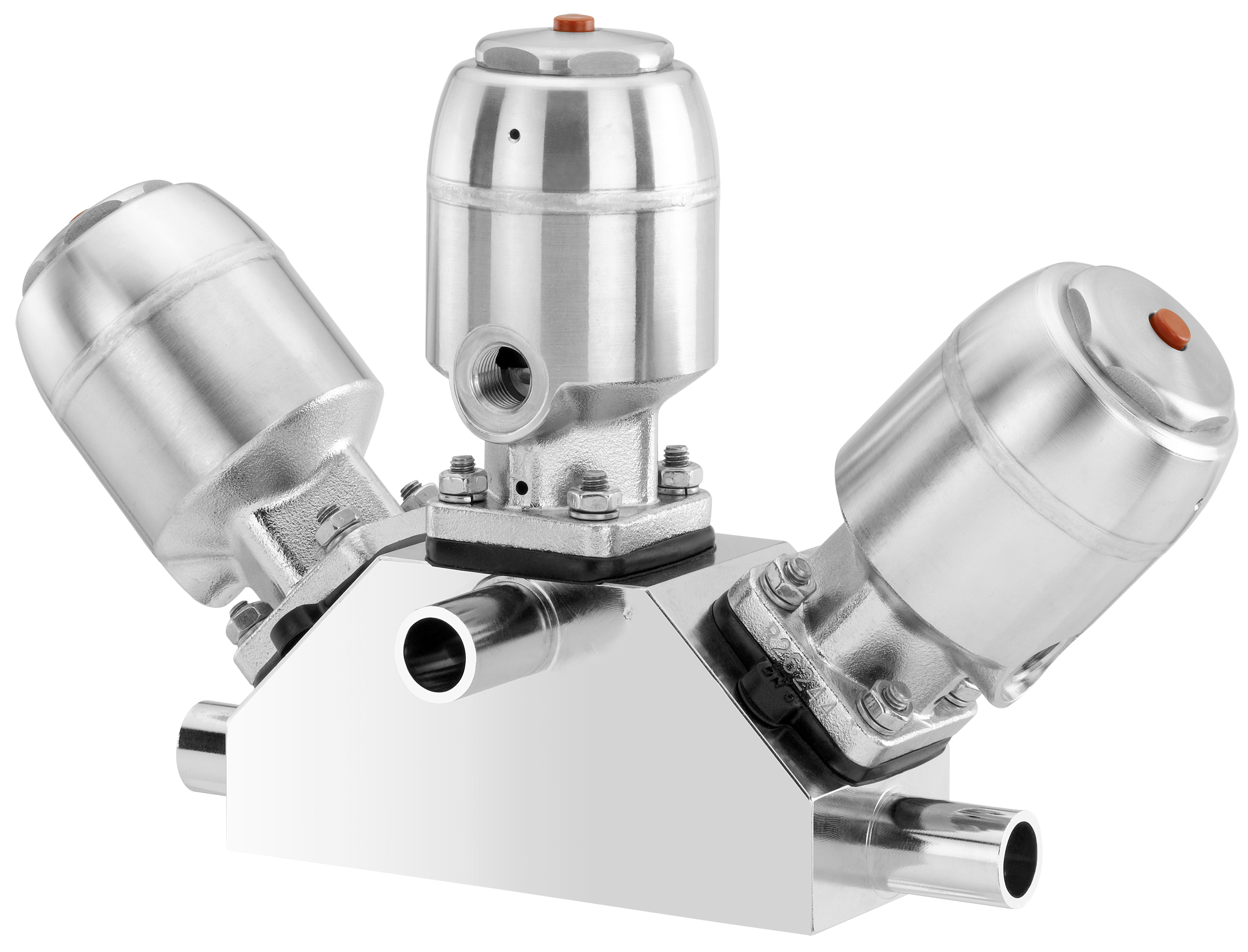
GEMÜ multi-port valves for pharmaceutical, food and biotechnology industries
Block-and-bleed solutions for the pharmaceutical, food and biotechnology industries
GEMÜ multi-port valves are used when the most varied process requirements and functions need to be united in the smallest of spaces in the pharmaceutical, food and biotechnology industries.
GEMÜ's block-and-bleed solutions also make a valuable contribution to process reliability during maintenance and calibration work or to avoiding cross contamination, and make practical implementation far easier.
Depending on the application, various configurations are available here for shutting off (block) and draining or venting (bleed) that differ in terms of construction. The complex piping system, for example with fittings and valves, is not required in this case.
The different design versions of the block-and-bleed functions can be categorised into the following groups:
1. Simple block-and-bleed valves
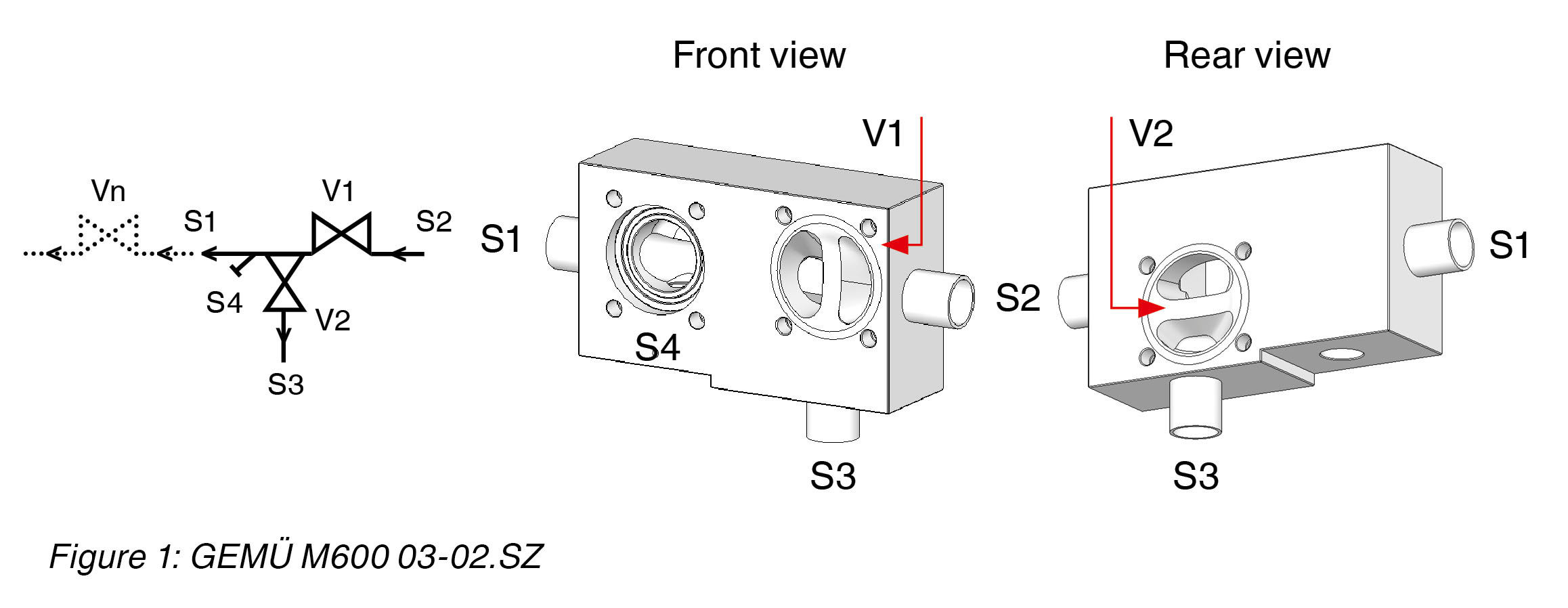
In the simplest version, block-and-bleed valves have two valve seats (Figure 1: V1, V2) and are generally used to allow you to safely remove installed in-line measurement devices from the system for maintenance or calibration work. An additional valve (Vn) is required to provide the necessary pressure compensation. In this configuration, the valve is positioned separately at a suitable point in the subsequent piping, and is not integrated in the valve block.
The V1 shut-off valve and the separate Vn valve are closed before the measurement device is removed from the S4 connection spigot. The V2 draining or venting valve is then opened. Only when both steps have been completed can the measurement device be removed and reinstalled after the completion of the work. By subsequently closing the V2 valve and opening the V1 and Vn valves, the measurement device is integrated back into the system.
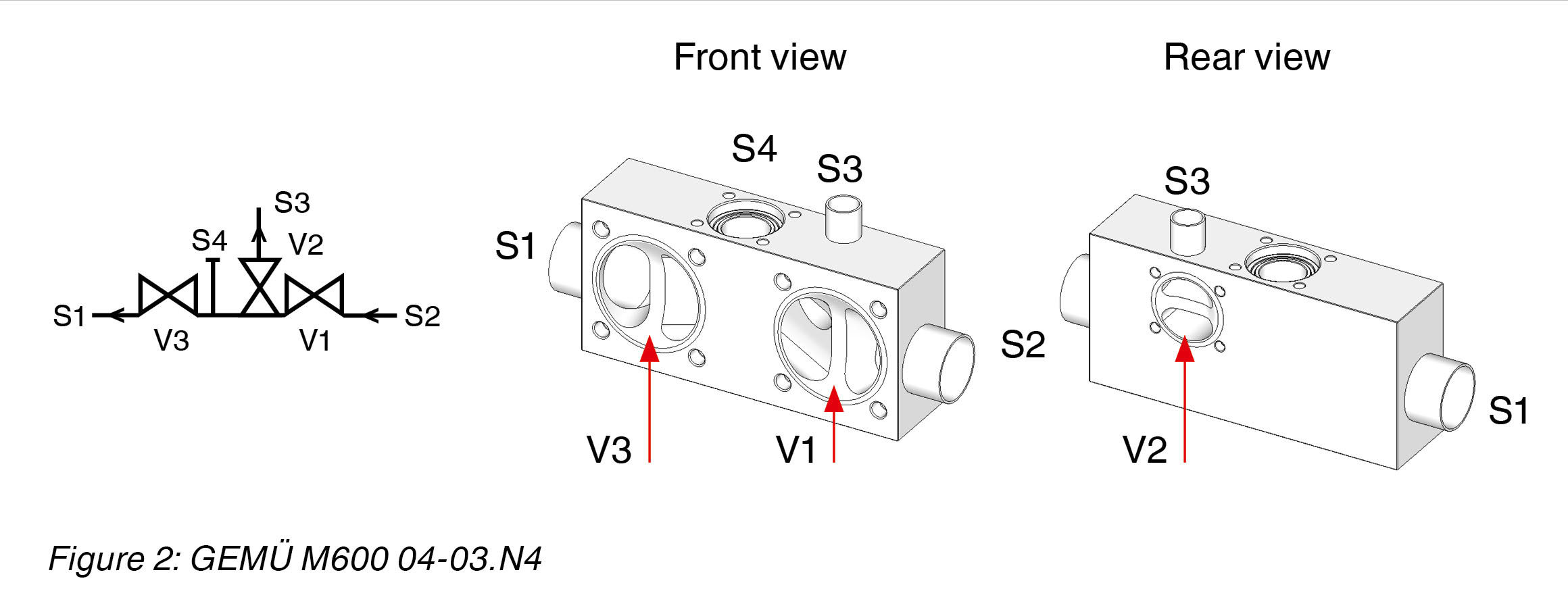
A further developed M-block solution is shown in the following example. All the previously mentioned valves and process connections are combined in one block here. The incorporated seal contour for the measurement device and the additionally integrated valve (V3) lead to a significant reduction of dead spaces. In this case, the S3 venting connection is aligned vertically upwards:
2. Double block-and-bleed valves
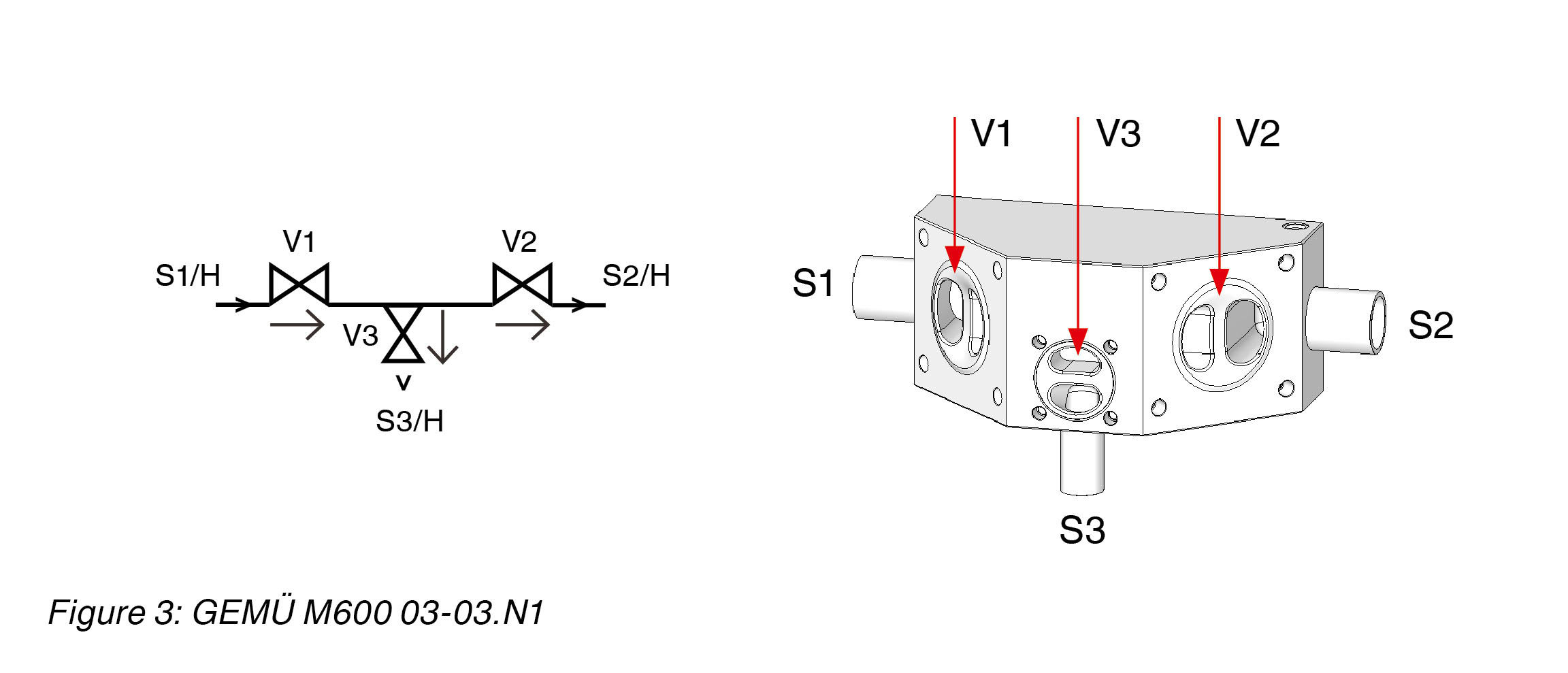
Double block-and-bleed valves with three integrated valve seats are generally used for critical process applications.
In contrast to shutting off with only one valve seat, the double shut-off integrated in a valve body ensures reliable separation of media. This function for creating a redundant barrier between two incompatible media is used, for example, if the product to be processed is present on the side of the S1 connection and the cleaning medium is present on the side of the S2 connection. The two V1 and V2 valves are closed here, and the V3 valve is open.
This method of double shut-off is also described in ASME BPE in chapter SD-3.1.2.3 (b) as a measure to avoid cross contamination of product streams.
This means that if one of the two seals of the V1 or V2 valve fails, another seal is still available as a shut-off (double block). In addition, the simultaneously open V3 valve (bleed) ensures that no pressure can build up between V1 and V2. Cross contamination of the products that are present can therefore be prevented. In addition, it is possible to determine a leakage visually or by means of automated detection via the open V3 valve.
4. 'Sterile cross' valves (steam barrier)
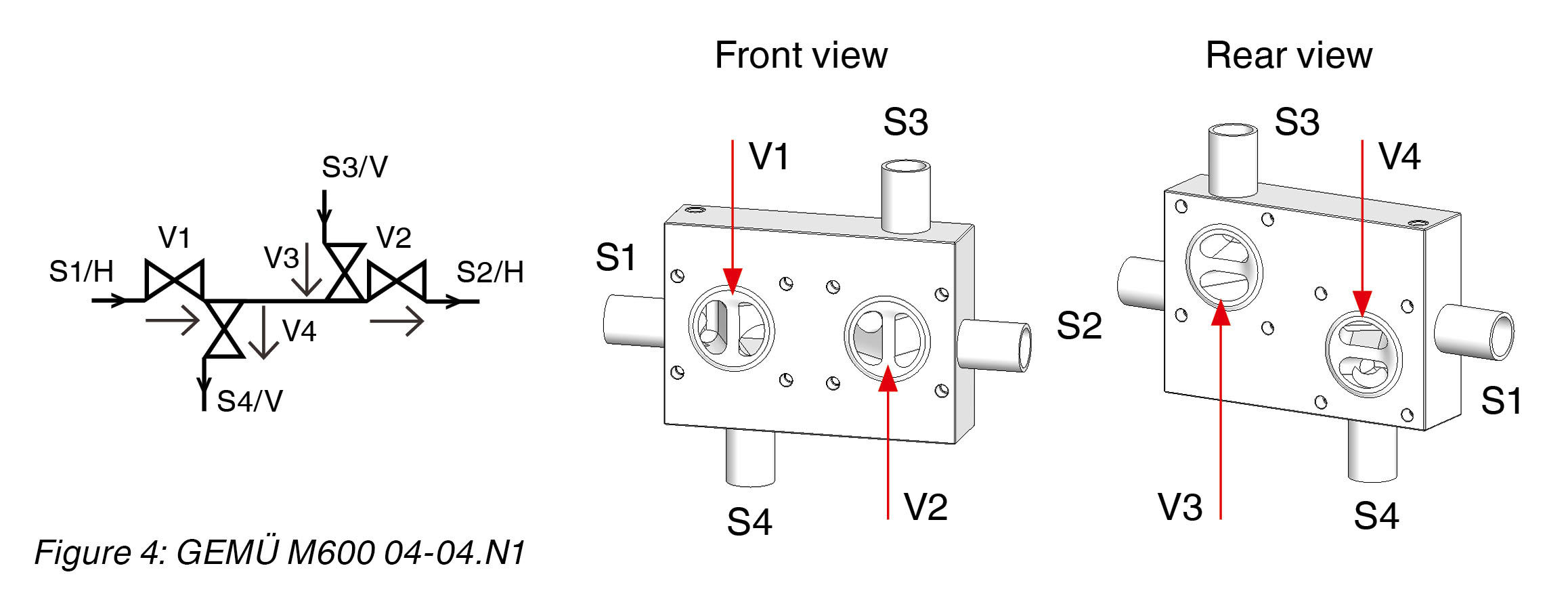
In comparison with double block-and-bleed valves, multi-port valve blocks used as a 'sterile cross' have an additional valve seat with a corresponding connection, meaning that this combination consists of a total of four valve seats and four connections.
This construction enables a permanent moisture barrier between the two closed valve seats (V1 and V2) during operation, eg to prevent contamination of the respective media present. Steam is introduced here through the open V3 valve via the S3 connection, and flows out again as steam or condensate at the S4 connection via the common connection chamber at the V4 valve.
5. Complex block-and-bleed valves
Based on the design of multi-port valves, complex block-and-bleed valves can be individually designed in accordance with the special process requirements and depending on the function requirement.
The construction and the number of connections and valve seats will vary depending on the number of media to be combined so as to be mixproof. An example of this is 'crossover cleaning' with two double block-and-bleed functions. The two double block-and-bleed functions (V1/V2/V5 and V3/V4/V8) are required to prevent contamination of the product during upcoming CIP cleaning, and can be implemented either via three different multi-port valves or via a complex multi-port valve block (M600 06-08.N) as shown below.
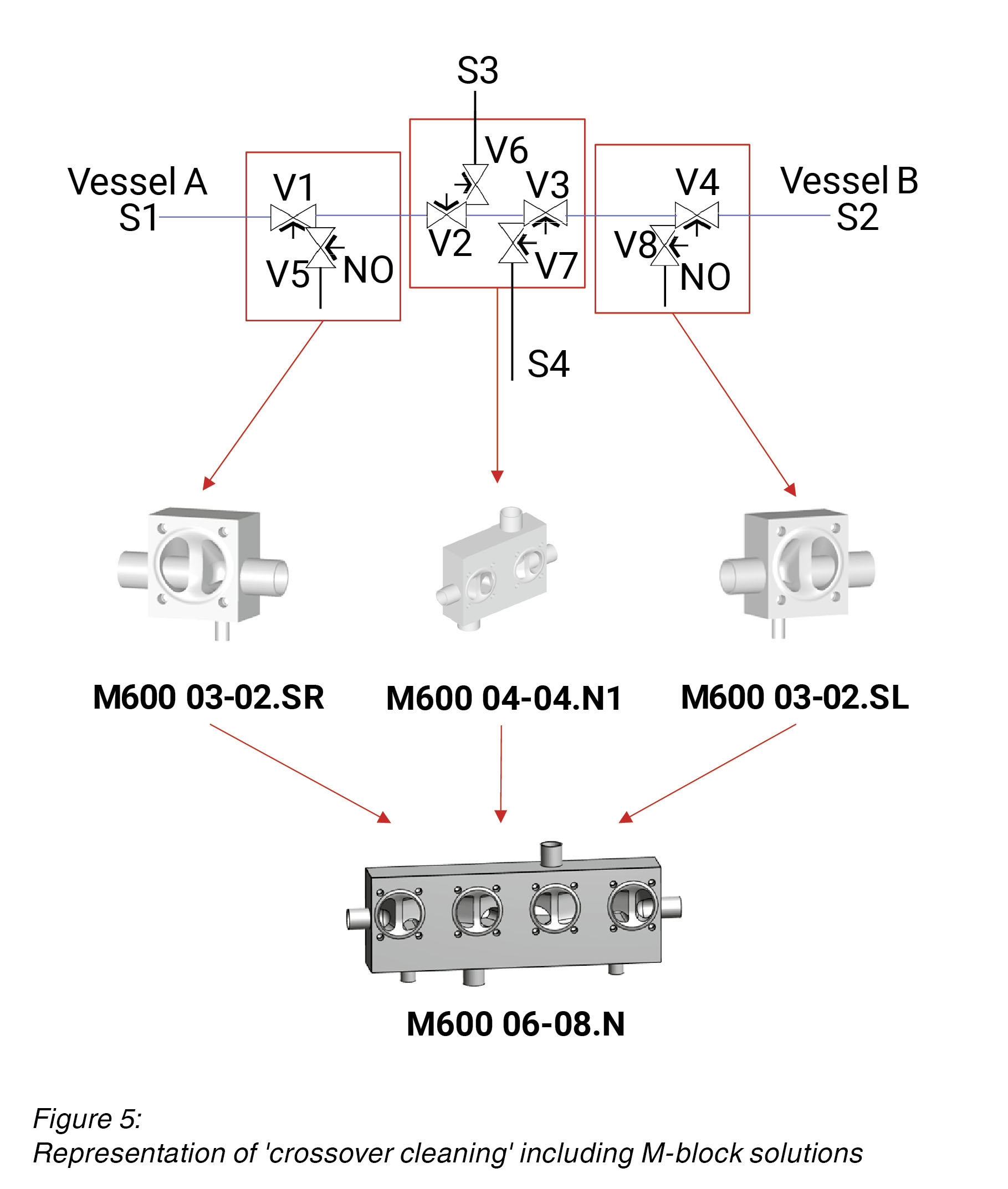
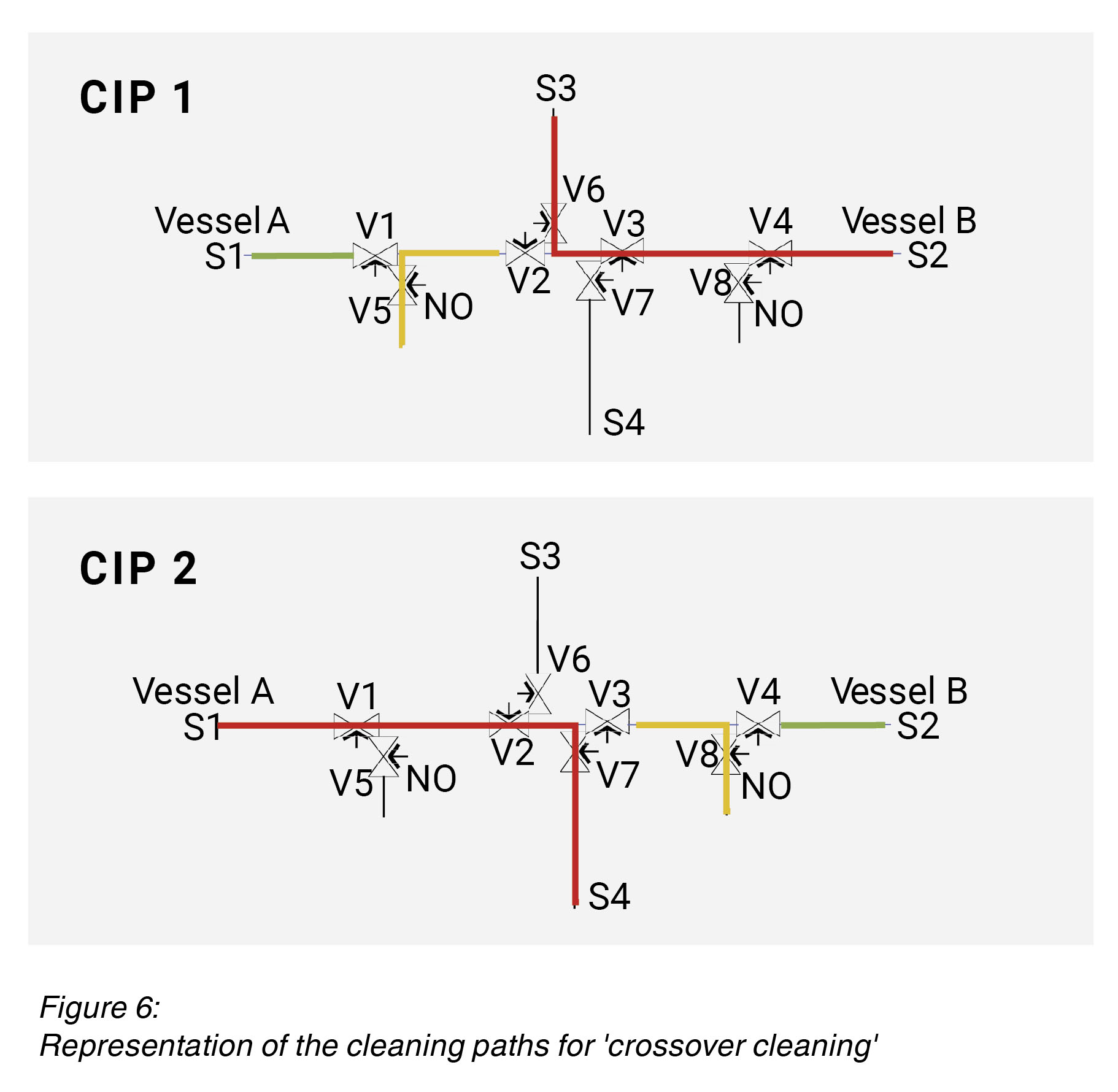
This arrangement of the multi-port valves allows two different process paths to be cleaned via cleaning-in-place (CIP) (Figure 8, shown in red), with part of this route overlapping ('crossover').
Before the product is transferred from container A to container B, the cleaning medium is introduced via the S3 connection and the V6, V3 and V4 valves (CIP 1). The V1, V2, V7 and V8 valves are closed here.
The open V5 valve allows the cleaning medium to run off if the V2 valve is leaking (pipe section shown in yellow), thus preventing contamination of the product found in container A (green).
After the product has been transferred from container A to container B, the piping of container A can be cleaned via the S4 connection (CIP 2). The V3, V4 and V6 valves are closed here, and the V8 valve is open (yellow/green). In this case, the cleaning medium flows from container A, via the open V1, V2 and V7 valves and in the direction of S4. The V5 valve, which was previously still open, is now also closed.
Customised solutions should definitely be presented in a block solution with minimal deadleg for all conceivable applications.