

- Services provided
- Product manufacture
- Product supply
- Project location
- Outside the UK
- Products used
- WET150 multi-parameter soil sensors
On Watamu Beach, Kenya, scientists from Swansea University and local conservationists have joined forces to protect endangered turtles by understanding how their nests respond to a warming climate.
The initiative aims to understand how environmental conditions influence hatching success and the temperature-dependent sex determination of sea turtles.
Objectives
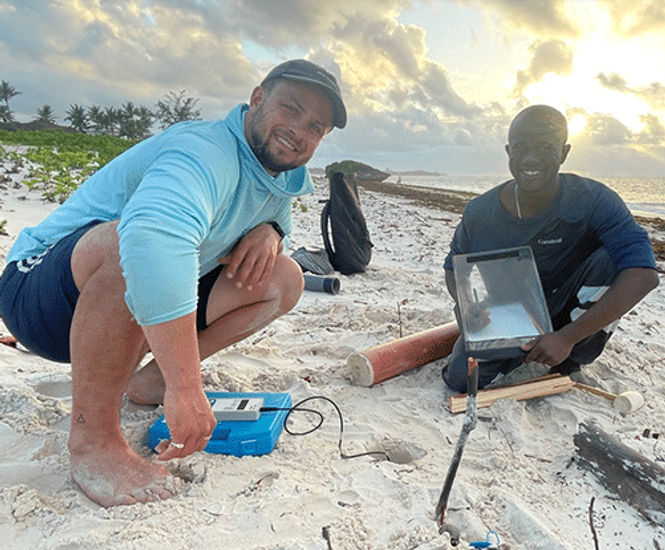
A 10-day field expedition from Swansea University established a data-gathering network on Watamu Beach, an important nesting site for Olive Ridley and green sea turtles.
Handheld WET150 multi-parameter soil sensors from Delta-T Devices were used to collect spot measurements across 3 zones of the beach, capturing sand moisture, temperature and salinity variations at depths from 5-60cm. This environmental characterisation of the beach helps inform a predictive model, providing data on how these parameters affect nest incubation conditions.
A data-rich approach allows researchers to investigate how microclimate shifts are affecting hatchling outcomes. In particular a troubling trend: rising nest temperatures skewing hatchling sex ratios heavily toward females, an imbalance that could jeopardise species survival.
"Temperatures just a few degrees higher can shift entire hatchling cohorts to female" says Nicole Esteban from Swansea University, "over time it will seriously destabilise population dynamics."
Research methodology and use of sensors
Individual nest monitoring has traditionally been the norm, but this project introduces a broader, more predictive strategy. Using data from WET150, the research team aims to develop a model correlating temperature with beach characteristics like depth, zone and seasonal climate. This will allow users to estimate nest temperature profiles without disturbing or accessing nests.
"We're trying to move beyond reactive conservation by creating a predictive model that tells us how nest conditions are likely to evolve across the beach" says Fred Baggs. "The WET150 sensors give us the data resolution and reliability needed to build those frameworks."
WET150 allows the team to measure salinity, water content and temperature simultaneously with instant readings in the field; previously these measurements would have needed to be completed in the laboratory. The team selected the WET150 soil sensor for its robustness in harsh coastal environments and accuracy across a wide temperature range.
The WET150 probes provide a non-intrusive way to measure these important aspects of sea turtle incubation environments.
“The WET150 sensors are doing exactly what we hoped – delivering clean, consistent data in the field,” Baggs adds. “They’re key to understanding how small variations in sand conditions affect hatching outcomes.”
Community engagement and scientific innovation
The initiative is built on a collaboration with Local Ocean Conservation (LOC). LOC is currently doing conservation work in the region, including a fisheries bycatch program that helped release 24,000 turtles, and nightly monitoring of nest activity.
The team hopes its research can support LOC's conservation efforts further. LOC's knowledge of sea turtle nesting behaviour and beach dynamics was crucial for sensor deployment and site planning, while the team from Swansea University provided expertise in experimental design and data collection methodology.
"The LOC team knows this beach better than anyone - they've been instrumental in helping us decide where and how to deploy the sensors for the most useful data" notes Baggs. "It's a true collaboration between local field experience and scientific modelling."
The Swansea University team and LOC worked closely together to:
Develop a reliable prediction model for nest temperature and resulting sex ratios.
Create user-friendly tools to help conservationists visualise and manage nesting conditions.
Train local teams in the use of these tools for real-time decision-making.
Future impact and conservation outcomes
The project is expected to improve local capacity for sea turtle protection. By providing predictive insights into sex ratios and identifying optimal nesting conditions, the system will inform timely interventions including nest relocation or irrigation during dry periods.
The work supports efforts to mitigate climate change on one of the worlds most vulnerable marine species, and empower local conservation teams with data driven tools for smarter management.
Esteban concludes "The WET150 sensor has been a great fit for our experimental needs. By improving the precision and foresight of sea turtle conservation efforts, this project represents a vital step in counteracting reproductive threats posed by a warming climate."
The WET150 sensor
Measures moisture, temperature and pore water EC
Accurate monitoring of soil/substrate conditions
Can be installed or used in portable kit form
Digital SDI-12 for easy system integration
Detachable and extendable cable system
5-year warranty