



- Media treated
- Wastewater / effluent
- Sector
- Wastewater treatment
- Open / enclosed
- Open
- Lamp pressure
- Medium pressure
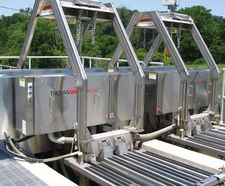
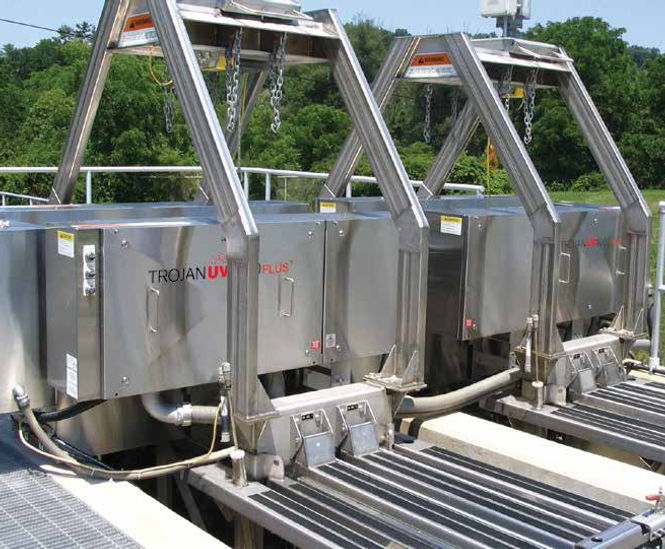
The TrojanUV4000Plus™ is the first commercially-successful, medium-pressure UV-lamp system specifically designed for handling high volume and lower quality wastewater.
Incorporating ActiClean™ – automatic chemical / mechanical cleaning technology – the TrojanUV4000Plus™ is the ultimate solution for a virtually maintenance-free system.
With over 375 installations – including some of the largest wastewater treatment plants in the world – the TrojanUV4000Plus™ is allowing engineers and operators to incorporate chemical-free, UV disinfection for large flows of 1,578m3/hr and greater in a minimal amount of space – with a fraction of the number of lamps required by low-pressure systems.
The extremely compact system can be used for low UV transmittance applications previously unattainable with ultraviolet technology.
It also offers the flexibility to treat a wide range of wastewater; from primary, secondary and blended effluents to combined and sanitary sewer overflows to water for reuse applications.
Features and benefits
Designed for challenging and large-scale applications
High intensity medium-presure lamps provide effective treatment of very low UV Transmittance (UVT) effluent (as low as 15%) and large flows since the UV output is significantly higher than low-pressure lamp systems. Its footprint is significantly smaller compared to other low-pressure UV lamp systems or chlorine disinfection system (typically 1/8th to 1/15th of the space) due to the high UV output of the lamps.
Unsurpassed chemical / mechanical sleeve cleaning
The automatic chemical / mechanical sleeve cleaning system (also known as ActiClean™) eliminates sleeve fouling without disrupting the disinfection process, thereby reducing downtime and O&M costs.
Dose pacing reduces O&M costs
The high-efficiency ballasts can vary the lamp power to 30-100% in order to match the required UV dose with the effluent quality and the flow rate. This allows plants to minimise their power consumption by dimming the lamps when the plant is operating at average conditions.
Design flexibility reduces installation costs
The reactor is designed for simplified retrofit into existing chlorine contact tank infrastructure, minimising construction costs – and leaving the majority of the contact tank available for storage, by-pass or emergency back-up. Electronic ballasts are inside the modules, eliminating the need for large ballast panels mounted beside the UV channel. Furthermore, all system components can be installed outdoors - eliminating the need to build a climate-controlled building.